
How to Grade a PEZ
Grading tells you what your PEZ is actually worth. Every price in the guide is the Near Mint value; a dispenser in another condition is worth a fraction of that number. Pick the grade honestly and the value follows.
The five grades
Gem Mint125% of guide value
Flawless, better than store-new. Zero faults, crisp color, tight spring.
Near Mint100% of guide value
Looks perfect at arm's length. At most a tiny fault a collector must hunt for.
Fine60% of guide value
A few visible faults: light paint wear, small marks or mild fade. Nothing broken.
Good33% of guide value
Well loved. Heavy wear, multiple faults, or any broken or missing piece.
Poor12% of guide value
Damaged and incomplete. A placeholder until a better one comes along.
Counting faults
The original 2006 PEZ Price Guide graded on a 0 to 10 scale by counting faults. It still works, and it keeps you honest:
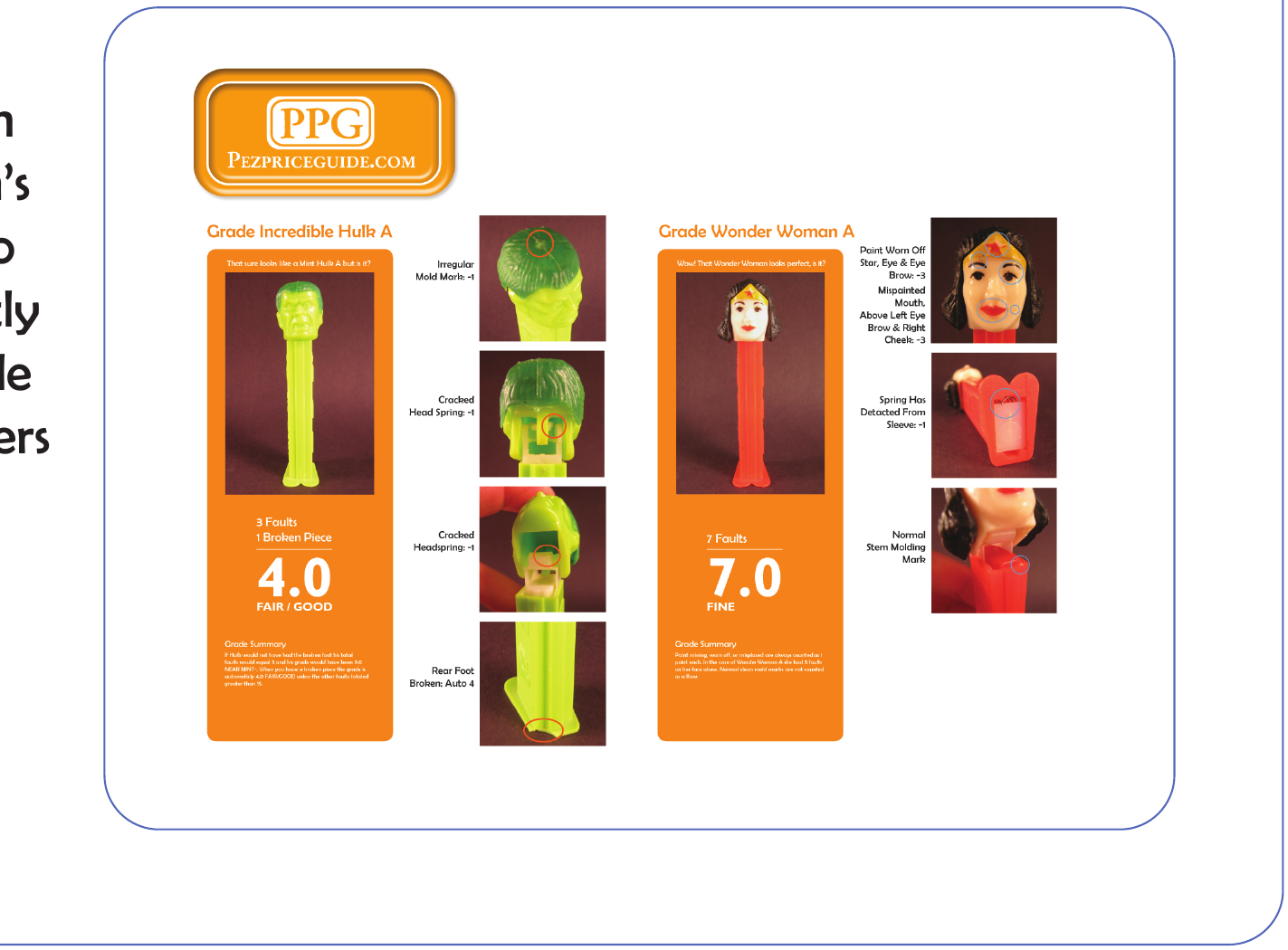
- Every defect counts as 1 fault: a scratch, a scuff, a chew mark, a crack.
- Paint that is missing, worn, or misprinted counts 1 fault for each spot.
- Normal, clean mold marks are part of manufacturing and are never faults.
- Any broken piece caps the grade at 4.0 (Good), no matter how clean the rest is. A dispenser that would have graded Near Mint drops straight to Good the moment something is broken.
Worked examples
From the original 2006 PEZ Price Guide grading standard: a Hulk A with 3 faults plus one broken piece grades 4.0, it would have been a 9.0 Near Mint without the break. A Wonder Woman A with 7 faults grades 7.0 Fine.
Carded and packaged items
For an item still on its card or in its package, grade the card or package with the same five grades. The item is worth its weakest grade: a Near Mint dispenser on a Good card is valued as Good. You can record both grades on any collection entry.
Card and package faults have their own names. Count them the same way, one fault each:
- Creases and bends in the card, including soft corner dings. A hard crease across the artwork is the card version of a broken piece: it caps the card at Good.
- Blister damage: yellowing, cloudiness, crush dents, or a blister lifting off the card.
- Hang hole tears or a punched hole that has ripped through.
- Price stickers and residue: an original store sticker is minor, torn paper or sticky residue where one was peeled counts.
- Edge wear and color fade from sun or shelf time.
- For bagged items, a factory sealed bag with clean print grades on the same scale. An opened or resealed bag is Good at best.
A card with zero faults and bright color is Gem Mint. One or two minor faults is Near Mint. Visible shelf wear is Fine. Anything creased, torn, or resealed is Good or below.
Ready to put grades on your own dispensers? Open your collection or browse the price guide.